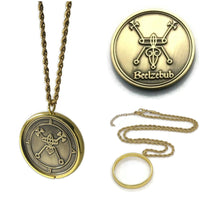
A sacred symbol, faithfully reproduced from the Greater Key of Solomon. Solid brass with the 72 Names of God on the reverse, made to be worn close, carried, or kept as a quiet reminder.
Bael demon sigil coin Ars Goetia features a double sided brass design inspired by classical Solomonic manuscripts. This coin presents traditional sigils associated with Bael, offering a detailed collectible for those interested in historical symbolism and Western esoteric traditions.
Bael Demon Sigil Coin - Meaning and Historical Context
This Bael demon sigil coin is based on traditional sources such as the Lesser Key of Solomon. Bael is described as a King within the Ars Goetia, associated with authority, structure, and symbolic interpretation.
Bael sigil: drawn from classical manuscripts
Ars Goetia: historical grimoire of spirit hierarchies
King classification: part of traditional systems
Symbolic design: focused on structure and calligraphic form
Because of this structure, the coin serves as both a collectible and a study piece.
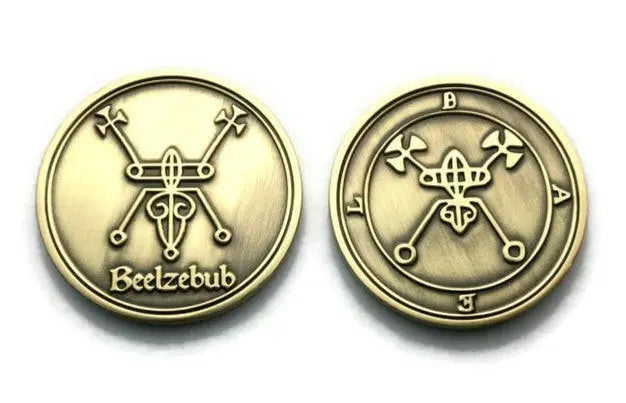
Primary Sigil of Bael (Side 1)
The front side displays the primary seal associated with Bael. This design is based on traditional illustrations found in historical texts.
The sigil reflects structured line work and symbolic arrangement. It is often studied for its visual composition and historical significance.
Alternate Bael Sigil (Side 2)
The reverse side presents an alternate historical rendering of the Bael sigil. This version appears in variant manuscript traditions and comparative studies.
By comparing both sides, collectors and researchers can observe differences in symbolic representation. This adds depth to the study of sigil variations.
Historical Context
Bael is listed as the first spirit in the Ars Goetia. Classical texts associate this figure with authority, concealment, and transformation within symbolic systems.
These interpretations reflect allegorical concepts found in Renaissance era esoteric literature.
Craftsmanship and Material
This coin is made from durable brass with a gold tone finish. The material provides strength while maintaining a classic and collectible appearance.
In addition, the engraving highlights fine details of both sigils. This ensures clarity and precision for study and display purposes.
Product Details
Material: brass
Color: gold tone
Diameter: 1.50 inches
Thickness: 2.9 mm
Weight: 0.8 oz
Design: double sided engraving
Packaging: PVC coin sleeve
This Bael demon sigil coin is designed for durability, historical detail, and collectible value.
Intended Use
This coin is created for collection, display, and educational study. It is suitable for those interested in historical manuscripts, symbolic systems, and Western esoteric traditions.
No rituals or instructions are included or implied.
Learn More About the Ars Goetia
This coin is part of the Ars Goetia series. Visit the full reference page to explore all 72 seals from the Lesser Key of Solomon.
Deeper Meaning of Bael
Bael occupies the first and highest position in the Ars Goetia, commanding 66 legions of spirits and holding the rank of King. The Lemegeton calls him a King ruling in the East, while the later correspondence tables place him under Göap, the ruler of the South. The name carries strong etymological connections to the Semitic root ba'al, meaning lord or master, a title applied to numerous regional deities across the ancient Near East and attested in Ugaritic, Phoenician, and Hebrew sources. This linguistic heritage made Bael a natural candidate for inclusion in Renaissance demonological catalogues, where older divine figures were reinterpreted as subordinate spirits within a Christian cosmological framework. The spirit appears in the Pseudomonarchia Daemonum of Johann Weyer (1563) and in the English Lemegeton Clavicula Salomonis, compiled in the 17th century but drawing on older Continental grimoire traditions. The Lemegeton says Bael appears in divers shapes, sometimes like a cat, sometimes like a toad, sometimes like a man, and sometimes all these forms at once, and that he can make a person go invisible. Later illustrators combined these forms into a single figure with three heads, most famously in Collin de Plancy's Dictionnaire Infernal (1863 edition). The astrological attribution to Aries 0-4 degrees places Bael in the very first degrees of the zodiac, matching his position as the first spirit of the list.
Frequently Asked Questions
What rank does Bael hold in the Ars Goetia?
Bael holds the rank of King and is the first spirit listed in the Ars Goetia, commanding 66 legions. The Lemegeton describes him as a King ruling in the East; the later correspondence tables place him under Göap, the ruler of the South.
What is the historical origin of the name Bael?
The name Bael is widely connected by scholars to the Semitic root ba'al, meaning lord or master. This title was applied to numerous regional deities throughout the ancient Near East, appearing in Ugaritic, Phoenician, and Hebrew sources before being incorporated into Christian demonological literature during the medieval and Renaissance periods.
Why is Bael shown with three heads?
The Lemegeton says Bael appears sometimes like a cat, sometimes like a toad, sometimes like a man, and sometimes in all these forms at once. Later illustrators turned this into a single figure with the heads of a man, a toad and a cat, the best known version being the illustration in Collin de Plancy's Dictionnaire Infernal (1863 edition).
What historical sources describe Bael?
Bael appears in Johann Weyer's Pseudomonarchia Daemonum (1563) and in the English Lemegeton Clavicula Salomonis, a manuscript compiled in the 17th century but drawing on older Continental grimoire sources. The standard English edition is the 1904 translation published by S. L. MacGregor Mathers and Aleister Crowley.
What is on the Bael coin?
Side 1 shows the primary sigil of Bael and side 2 an alternate historical rendering of the same sigil. Brass with gold tone finish, 1.50 inches diameter, 2.9 mm thick, PVC sleeve.
Each Solomonic seal in our collection is preserved in the medieval grimoire tradition known as the Greater Key of Solomon. Every piece is a faithful reproduction of the planetary, angelic, or geometric figure as it appears in the original manuscripts, paired on the reverse with the 72 Names of God: three-letter Hebrew sequences derived from Exodus 14:19 to 21 and traditionally used in Kabbalistic meditation. Read the full reference guide for the symbolism behind every seal.
Materials & Dimensions
Material: Solid brass with gold-tone finish
Diameter: 1.50 inches (38 mm)
Thickness: 2.9 mm
Weight: 0.8 oz
Engraving: Double-sided. Seal on the front, 72 Names of God on the reverse.
Shipping & Returns
Worldwide shipping. Free standard shipping on all US orders, with faster options available at checkout. Most US orders arrive within about 5 to 8 business days. International shipping is calculated at checkout and typically arrives in 3 to 5 weeks, depending on destination and carrier.
30-day returns. Not satisfied? Return any unworn coin or bracelet within 30 days of receipt for a full refund or exchange. Reach us at info@kingsolomoncoin.com.
How to Wear & Pair
Pair this coin with our 1FitAll Bezel Necklace: the modular bezel was designed to fit every coin in the King Solomon Coin collection, so you can swap coins between intentions or planetary days. The coin can also be carried in a pocket, kept on a personal altar, or used as a meditation focus.
So Happy I found this Authentic High Quality shop selling these original beautiful made to order Powerful Seals. I bought the Powerful Archangels Talisman and Bezel to wear as necklace and the Sigillum Dei Aemeth Coin - Protection Talisman, all with 72 Names of God. They all arrived in a secured and carefully wrapped package with lots of care and inside everything is so beautifully wrapped with love and heart and respect for the Sacred Seals and my purchase. The Seals are also very well made with clear inscriptions and feel solid and strong, with beautiful brass and color, and they are already 'activated' and blessed for us kindly by the Owner/Seller so that the Seals are ready for our protection and use once arrive. There's also a lovely thankyou note and handy card instructions on how to take care of the Seals. I can feel the Strong Powerful Protective energies when i opened the package and the Seals are so beautifully made and delightful i found myself holding my breath while taking these Sacred precious Seals in my hands. The Owner/Seller's after sales service is also SUPERB and Wonderful, a person with a lovely heart full of sincerity, kindness and understanding, answering my many questions ever so kindly and replying me so quickly and sincerely each time. I feel and notice the Seals are already working in effect even before i opened up the sealed packages. It is such a Well worth wait for these quality Seals to reach me all the way from US to Singapore. I believe because of these powerful blessed Seals, the shipment/flight during delivery and everywhere these Sacred Seals travelled past while enroute to my place, got blessed and protected as a result. God Bless Everyone at King Solomon Coin and ThankYou so much for all the hardwork and efforts that went into the studying and creating and manufacturing of these Sacred Holy works of Art and making them available to all.