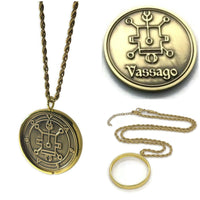
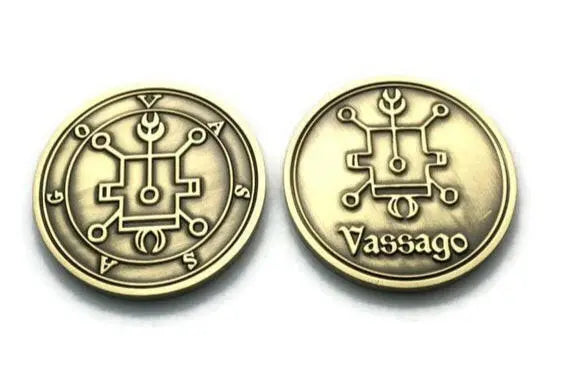
Vassago demon sigil coin Ars Goetia features a double sided brass design inspired by classical Solomonic manuscripts. This coin presents two traditional sigils associated with Vassago, offering a detailed collectible for those interested in historical symbolism and Western esoteric traditions.
Vassago Demon Sigil Coin - Meaning and Historical Context
This Vassago demon sigil coin is based on traditional sources such as the Lesser Key of Solomon. Vassago is described as a Prince within the Ars Goetia, associated with structured hierarchies and symbolic interpretation.
Vassago sigil: drawn from classical manuscripts
Ars Goetia: historical grimoire of spirit hierarchies
Prince classification: part of traditional systems
Symbolic design: focused on structure and calligraphic form
Because of this structure, the coin serves as both a collectible and a study piece.
Primary Sigil of Vassago (Side 1)
The front side displays the primary seal associated with Vassago. This design is based on traditional illustrations found in historical texts.
The sigil reflects structured line work and symbolic arrangement. It is often studied for its visual composition and historical significance.
Alternate Vassago Sigil (Side 2)
The reverse side presents an alternate sigil attributed to Vassago. This version appears in later sources and comparative studies of demonological traditions.
By comparing both sides, collectors and researchers can observe variations in symbolic representation. This adds depth to the study of sigil evolution.
Historical Context
Vassago is listed as the third spirit in the Ars Goetia. Classical texts describe this figure as associated with knowledge of hidden matters and symbolic interpretation of past and future.
The name also appears in variant forms such as Pruflas and Busas in historical sources. These variations reflect differences across manuscripts and traditions.
Craftsmanship and Material
This coin is made from durable brass with a gold tone finish. The material provides strength while maintaining a classic and collectible appearance.
In addition, the engraving highlights fine details of both sigils. This ensures clarity and precision for study and display purposes.
Product Details
Material: brass
Color: gold tone
Diameter: 1.50 inches
Thickness: 2.9 mm
Weight: 0.8 oz
Design: double sided engraving
Packaging: PVC coin sleeve
This Vassago demon sigil coin is designed for durability, historical detail, and collectible value.
Intended Use
This coin is created for collection, display, and educational study. It is suitable for those interested in historical manuscripts, symbolic systems, and Western esoteric traditions.
No rituals or instructions are included or implied.
Learn More About the Ars Goetia
This coin is part of the Ars Goetia series. Visit the full reference page to explore all 72 seals from the Lesser Key of Solomon.
Deeper Meaning of Vassago
Vassago holds the third position in the Ars Goetia and carries the rank of Prince, commanding 26 legions of spirits. What sets Vassago apart in manuscript sources is the unusual textual designation of being of good nature, a moral characterization rarely applied to spirits within the Goetic catalogue. This description has prompted scholarly discussion about the criteria used by grimoire compilers to distinguish between spirits viewed as favorable versus threatening, and may reflect older source traditions where Vassago's attributes were framed more positively than most Goetic spirits. The Lemegeton also describes him as being of the same nature as Agares. The variant names Pruflas and Busas appear across different manuscript traditions, illustrating the textual fluidity common to grimoire literature as it passed through multiple scribal hands over centuries of transmission. The association with revealing hidden, lost, or forgotten things and with knowledge of what has been and what is to come situates Vassago within the mantic tradition: spirits whose primary function in the symbolic imagination was to provide access to knowledge inaccessible through ordinary means. This function had particular resonance during the Renaissance, when the recovery of lost classical knowledge was a central intellectual preoccupation among humanist scholars. The sigil's distinctive loop-and-stem structure appears consistently across the major Lemegeton manuscript families, suggesting careful scribal transmission of this seal through the generations.
Frequently Asked Questions
What rank does Vassago hold in the Ars Goetia?
Vassago holds the rank of Prince and occupies the third position in the Ars Goetia. Vassago commands 26 legions of spirits.
Why is Vassago described as 'of good nature' in the Lemegeton?
The description of Vassago as 'of good nature' in the Lemegeton Clavicula Salomonis is unusual within the Goetic catalogue, where most spirits are described without moral characterization. Scholars interpret this designation as possibly reflecting older source traditions where Vassago's attributes were framed more favorably, or as a convention emphasizing the spirit's cooperative character within the manuscript's operational framework.
What variant names does Vassago appear under in historical manuscripts?
Vassago appears under the variant names Pruflas and Busas in different manuscript traditions. These variations reflect the textual fluidity common to grimoire literature as it passed through multiple scribal hands over centuries of transmission from Continental European to English manuscript traditions. Each variant name offers scholars additional evidence for tracing the textual genealogy of the Ars Goetia.
What is Vassago associated with in classical manuscript sources?
Classical sources associate Vassago with the revelation of hidden, lost, and forgotten things, as well as with knowledge of what has been and what is to come. This places Vassago firmly within the mantic tradition of the Goetic system, alongside spirits whose primary symbolic function was to provide access to knowledge inaccessible through ordinary means of inquiry.
What is the significance of Vassago's position as the third spirit in the Ars Goetia?
Vassago's position as the third spirit places it as the third of the six spirits attributed to Aries (Bael, Agares, Vassago, Samigina, Marbas and Valefor), each covering five degrees of the sign. The sequential attribution to Aries in classical astrological demonology reflects the use of zodiacal frameworks to organize the 72 spirits into groups connected to the twelve signs and their degree ranges.
Related Ars Goetia Seals
Bael (King, #1) | Agares (Duke, #2) | Samigina (Marquis, #4) | Marbas (President, #5) | Botis (President/Earl, #17) | Furcas (Knight, #50)