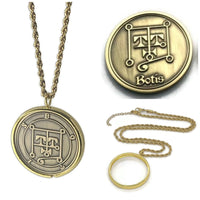
A sacred symbol, faithfully reproduced from the Greater Key of Solomon. Solid brass with the 72 Names of God on the reverse, made to be worn close, carried, or kept as a quiet reminder.
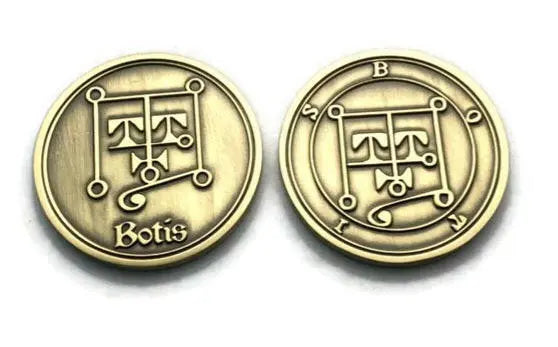
Botis demon sigil coin Ars Goetia features a double sided brass design inspired by classical Solomonic manuscripts. This coin presents two traditional sigils associated with Botis, offering a detailed collectible for those interested in historical symbolism and Western esoteric traditions.
Botis Demon Sigil Coin - Meaning and Historical Context
This Botis demon sigil coin is based on traditional sources such as the Lesser Key of Solomon. Botis is described as a President within the Ars Goetia, associated with structured hierarchies and symbolic representation.
Botis sigil: drawn from classical manuscripts
Ars Goetia: historical grimoire of spirit hierarchies
President rank: part of traditional classification
Symbolic design: focused on structure and calligraphic form
Because of this structure, the coin serves as both a collectible and a study piece.
Primary Sigil of Botis (Side 1)
The front side displays the primary seal associated with Botis. This design is based on traditional illustrations found in historical texts.
The sigil reflects structured line work and symbolic arrangement. It is often studied for its visual composition and historical significance.
Alternate Botis Sigil (Side 2)
The reverse side presents an alternate sigil attributed to Botis. This version appears in later sources and comparative studies of demonological traditions.
By comparing both sides, collectors and researchers can observe variations in symbolic representation. This adds depth to the study of sigil evolution.
Historical Context
Botis is listed as the seventeenth spirit in the Ars Goetia. Classical texts describe this figure as associated with knowledge of past and future events and symbolic mediation.
The imagery connected to Botis often includes serpent or horned forms. These elements represent authority, structure, and interpretation within historical manuscripts.
Craftsmanship and Material
This coin is made from durable brass with a gold tone finish. The material provides strength while maintaining a classic and collectible appearance.
In addition, the engraving highlights fine details of both sigils. This ensures clarity and precision for study and display purposes.
Product Details
Material: brass
Color: gold tone
Diameter: 1.50 inches
Thickness: 2.9 mm
Weight: 0.8 oz
Design: double sided engraving
Packaging: PVC coin sleeve
This Botis demon sigil coin is designed for durability, historical detail, and collectible value.
Intended Use
This coin is created for collection, display, and educational study. It is suitable for those interested in historical manuscripts, symbolic systems, and Western esoteric traditions.
No rituals or instructions are included or implied.
Learn More About the Ars Goetia
This coin is part of the Ars Goetia series. Visit the full reference page to explore all 72 seals from the Lesser Key of Solomon.
Deeper Meaning of Botis
Botis holds the seventeenth position in the Ars Goetia and carries the unusual distinction of holding two simultaneous ranks: President and Earl (also rendered as Count in some manuscript traditions). This dual classification makes Botis one of the most structurally anomalous entries in the Goetic catalogue and has been interpreted by scholars as evidence of conflated sources during the compilation of the Lemegeton. The Earl rank in classical demonological theory is typically associated with spirits governing specific natural phenomena, temporal cycles, and forms of knowledge connected to the observation of events past and future. The Lemegeton describes Botis as appearing first in the form of a horrible viper, then transforming into a human figure bearing large teeth and horns, a composite image that draws on serpent symbolism prevalent throughout Mediterranean and Near Eastern cosmological tradition, where the serpent represented primordial wisdom, cyclical time, and the boundary between hidden and manifest knowledge. The imagery of serpent-to-human transformation carries resonance within alchemical literature of the same period, where the serpent (particularly the ouroboros) symbolized the cyclical nature of philosophical transformation and the unity of opposites. Commanding 60 legions, Botis falls under Ziminar's governance as a northern-quarter spirit. The sigil design, with its characteristic angular crossings, appears with notable consistency across the major Lemegeton manuscript traditions, suggesting it was among the more carefully preserved seals in the corpus. Some manuscript versions also associate Botis with reconciliation between estranged parties, adding a relational dimension to this spirit's already complex textual profile.
Frequently Asked Questions
What ranks does Botis hold in the Ars Goetia?
Botis uniquely holds two simultaneous ranks in the Ars Goetia: President and Earl (also rendered as Count in some manuscript traditions). This dual classification makes Botis one of the most structurally anomalous entries in the Goetic catalogue. Botis commands 60 legions of spirits and falls under the governance of Ziminar, the northern directional king.
Why does Botis hold two ranks simultaneously?
The dual ranking of Botis as both President and Earl has been interpreted by scholars as evidence of conflated sources during the compilation of the Lemegeton. This suggests that Botis may have appeared in separate source traditions with different classifications, and the Lemegeton compilers preserved both designations rather than choosing one, resulting in the uniquely dual-ranked entry that appears in the final text.
How does Botis appear in classical manuscript descriptions?
Classical manuscripts describe Botis as appearing first in the form of a horrible viper before transforming into a human figure bearing large teeth and horns. This serpent-to-human transformation motif carries associations with primordial wisdom and boundary-crossing knowledge in Mediterranean and Near Eastern cosmological tradition, and also resonates with alchemical imagery of the same period where the serpent symbolized philosophical transformation.
What is Botis associated with in historical manuscript sources?
Classical sources associate Botis with knowledge of past and future events, placing this spirit within the mantic tradition of the Goetic system alongside other spirits whose primary function was to provide access to temporally extended knowledge. Some manuscript versions also associate Botis with reconciliation between estranged parties, adding a relational and social dimension to this spirit's textual profile.
What makes the Botis sigil distinctive among Goetic seals?
The Botis sigil features a characteristic pattern of angular crossings that appears with notable consistency across the major Lemegeton manuscript families, suggesting it was among the more carefully preserved and accurately transmitted seals in the corpus. This textual consistency is significant because many Goetic seals show considerable variation between manuscript versions, making Botis's sigil one of the more reliable reference points in comparative manuscript studies.
Each Solomonic seal in our collection is preserved in the medieval grimoire tradition known as the Greater Key of Solomon. Every piece is a faithful reproduction of the planetary, angelic, or geometric figure as it appears in the original manuscripts, paired on the reverse with the 72 Names of God: three-letter Hebrew sequences derived from Exodus 14:19 to 21 and traditionally used in Kabbalistic meditation. Read the full reference guide for the symbolism behind every seal.
Materials & Dimensions
Material: Solid brass with gold-tone finish
Diameter: 1.50 inches (38 mm)
Thickness: 2.9 mm
Weight: 0.8 oz
Engraving: Double-sided. Seal on the front, 72 Names of God on the reverse.
Shipping & Returns
Worldwide shipping. Free standard shipping on all US orders, with faster options available at checkout. Most US orders arrive within about 5 to 8 business days. International shipping is calculated at checkout and typically arrives in 3 to 5 weeks, depending on destination and carrier.
30-day returns. Not satisfied? Return any unworn coin or bracelet within 30 days of receipt for a full refund or exchange. Reach us at info@kingsolomoncoin.com.
How to Wear & Pair
Pair this coin with our 1FitAll Bezel Necklace: the modular bezel was designed to fit every coin in the King Solomon Coin collection, so you can swap coins between intentions or planetary days. The coin can also be carried in a pocket, kept on a personal altar, or used as a meditation focus.