Samigina Demon Sigil Meaning: Ars Goetia Marquis of Liberal Arts and Solomonic Seal Guide
Samigina Demon Sigil Meaning: Ars Goetia Marquis of Liberal Arts and Solomonic Seal Guide

The fourth spirit in the Ars Goetia occupies a striking position in the manuscript tradition. Samigina, also known as Gamigin or Gamygyn, is a Marquis commanding 30 legions. He appears first as a small horse or donkey, then transforms into a man. His powers are double-edged in their scope: he teaches the liberal arts, and he can speak to the souls of those who have died. This combination of learning and communication with the ancestors makes Samigina one of the most intellectually and spiritually layered figures in the entire catalogue of 72 spirits. This post traces his origins in the Solomonic manuscripts, examines his sigil, and explains the tradition in which this coin was made.
Who Is Samigina in the Ars Goetia?
The Ars Goetia is the first book of the Lemegeton Clavicula Salomonis, the Lesser Key of Solomon, compiled in the 17th century from earlier manuscript sources. Its 72 spirits are catalogued with names, ranks, visual descriptions, powers, and sigils. King Solomon is said to have bound these spirits using his divine ring, seal, and the authority of the 72 Names of God, commanding them to serve within a defined framework of purpose.
Samigina is the fourth spirit listed, holding the rank of Marquis and commanding 30 legions. In the Goetic hierarchy, Marquises tend to be associated with night, movement, and the crossing of thresholds, both literal and metaphorical. Samigina's opening form as a horse or ass places him in the tradition of spirits associated with travel, carrying, and the crossing of distances: the horse was the primary means of covering ground quickly in the world that produced these manuscripts.
His transformation into a man follows the same pattern as several other Goetic spirits: the initial form is elemental and animal, the final form is human and accessible. This transformation suggests a movement from raw natural force into focused, communicable knowledge. What the horse crosses in physical space, Samigina crosses in intellectual and temporal space: the distance between the living and the dead, the gap between what is not yet understood and what the liberal arts teach.
The liberal arts in the medieval sense comprised the Trivium (grammar, rhetoric, and logic) and the Quadrivium (arithmetic, geometry, music, and astronomy). These seven disciplines formed the complete framework of educated knowledge in the pre-modern West. A spirit who teaches all of them is offering access to the full structure of learning, not one subject or skill but the entire architecture of how to think, calculate, and perceive the world's patterns.
The Sigil of Samigina: Origins and Manuscript Tradition
The sigil of Samigina is the geometric mark assigned to him in the Solomonic manuscripts, derived through the standard Goetic process of converting the spirit's name into a connected visual form using a magical cipher system. These sigils were treated as precise technical instruments: the correct mark for the correct spirit, transmitted with care across manuscript copies.
The Samigina sigil appears in the Sloane manuscripts at the British Library, in the Mathers-Crowley edition of the Goetia published in 1904, and in several related manuscript traditions. His name appears in three forms across these sources: Samigina, Gamigin, and Gamygyn, reflecting the multiple layers of transliteration the text passed through before arriving in English. Each form preserves the same core sounds and the same sigil design, confirming that scholars and copyists understood they were working with the same spirit despite the spelling variations.
The visual form of the Samigina sigil contains a flowing central element with angular termination points, which has been read as suggesting the movement quality of his nature: the crossing from one state (ignorance, or mortality) to another (learning, or communication with what lies beyond). The specific visual form is less important than its function as an accurate identifier in Solomonic practice, but the consistency of the form across three centuries of manuscript transmission is itself evidence of how seriously the tradition took its sigils.
Samigina and Communication with the Ancestors
The second major power attributed to Samigina in the Solomonic manuscripts is the ability to communicate with the souls of those who died in sin, to tell of their state and what they experienced after death. This places Samigina in the necromantic tradition, one of the oldest and most widespread forms of spiritual practice in human history: the attempt to communicate with those who have died.
In the medieval context, communication with the dead was both spiritually significant and practically valuable. Questions of inheritance, of unfinished business, of sins requiring confession or amends: these were real concerns for which access to a deceased person's perspective could be enormously important. The phrase died in sin suggests that Samigina was specifically sought in cases where a person died without resolution, where something was left undone or unspoken.
In contemporary talisman practice, the ancestral communication quality of Samigina is understood broadly. People carry his sigil when working to understand their family history, to make sense of inherited patterns in their lives, or to process grief and the questions that arise when someone important to them has died. The specific mechanics of how Samigina's power operates are less important than the intention it supports: turning toward rather than away from what the ancestors carry.
Liberal Arts and Ancestral Wisdom: One Tradition
The combination of liberal arts teaching and ancestral communication in Samigina's profile is not as paradoxical as it might first appear. Both powers concern the transmission of knowledge across a gap: the gap between ignorance and learning, and the gap between the living and the dead. In the Solomonic worldview, these are expressions of the same underlying capacity.
The liberal arts as transmitted from antiquity to the medieval period were themselves a form of ancestral transmission: the preserved knowledge of the ancient Greeks, Romans, and Hebrews passed forward through centuries of copying, commentary, and teaching. To learn grammar was to receive from Priscian and Donatus. To learn geometry was to receive from Euclid. To learn music theory was to receive from Pythagoras and Boethius. All learning is, in a sense, communication with those who have died.
Samigina bridges both directions of this transmission. He teaches the living what the past has produced, and he can speak to those who have already crossed the threshold. He is a figure of continuity between what has been and what is being learned now.
How the Samigina Sigil Coin Is Made
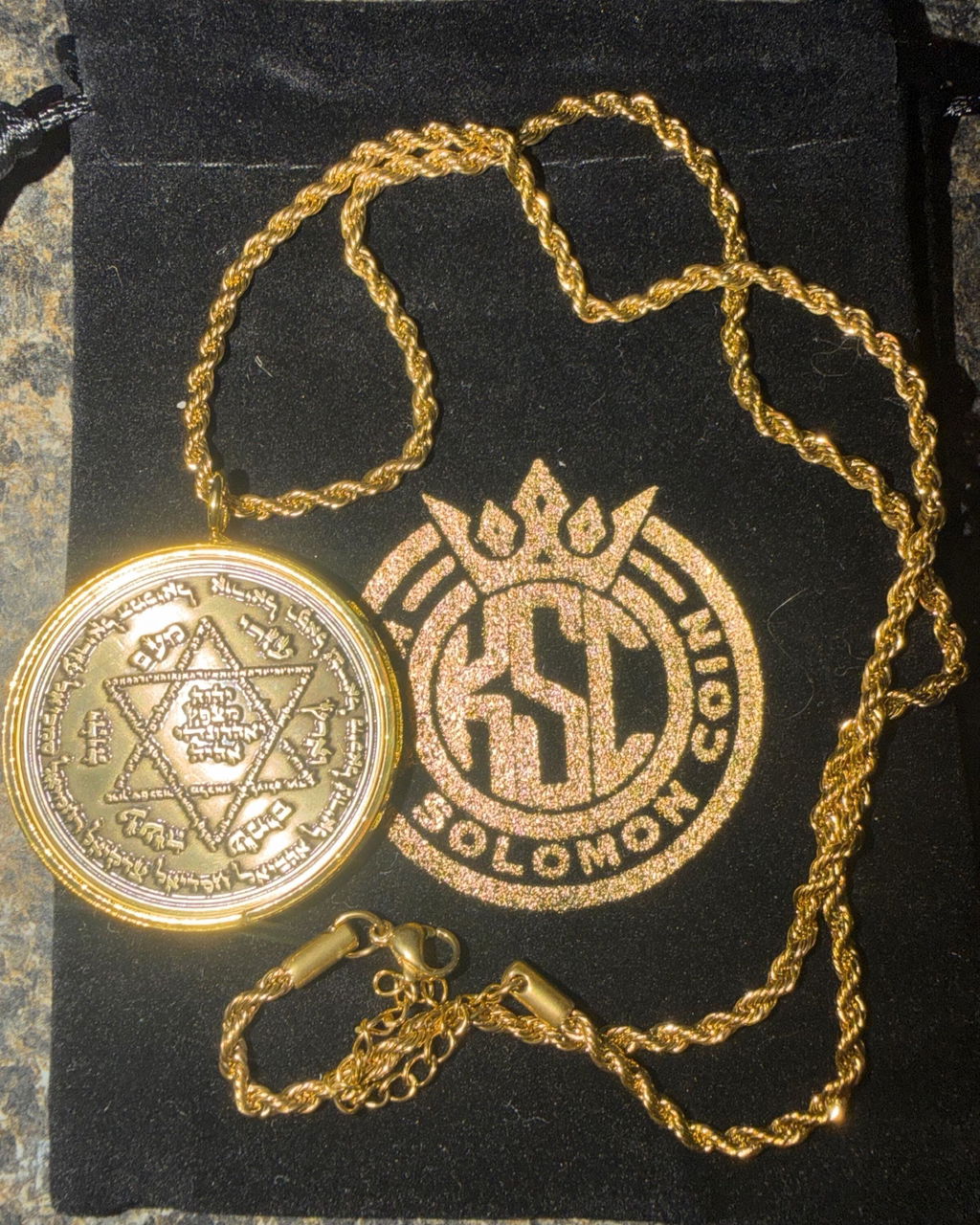
This coin is struck in solid brass and carries the sigil of Samigina on the front face, reproduced from the historical Ars Goetia manuscript tradition. The reverse carries the 72 Names of God in Hebrew, the same divine names that in the Kabbalistic tradition gave Solomon his authority over all 72 spirits. Their presence on the reverse places the sigil within the complete Solomonic framework: spirit named on one face, divine authority named on the other.
The 72 Names are engraved only on the first day of the Hebrew month, following the traditional requirement maintained by the maker of these coins from the beginning of this practice. The coin is made to carry, to wear, and to use as a focal point for intention in whatever way is meaningful to the person holding it.
Frequently Asked Questions About Samigina
What is the Samigina sigil used for?
In the Solomonic tradition, Samigina teaches the liberal arts (grammar, rhetoric, logic, arithmetic, geometry, music, and astronomy) and communicates information concerning those who have died. In talisman practice, the sigil is carried as a focal point for learning, intellectual development, and work involving ancestral or family history.
Is Samigina the same as Gamigin or Gamygyn?
Yes. All three names (Samigina, Gamigin, Gamygyn) refer to the same spirit across different manuscript traditions. The variations reflect the different transliteration systems the name passed through as the Ars Goetia was copied and translated across languages and centuries. All versions carry the same sigil and the same attributed powers.
What rank does Samigina hold in the Ars Goetia?
Samigina holds the rank of Marquis, commanding 30 legions of spirits. Marquises in the Goetic hierarchy are often associated with night, movement, and crossing boundaries. Samigina is one of the most prominent Marquises in the text given his position early in the list and his broad range of attributed powers.
What are the liberal arts that Samigina teaches?
The seven liberal arts in the medieval tradition comprised the Trivium (grammar, rhetoric, and logic) and the Quadrivium (arithmetic, geometry, music, and astronomy). These formed the complete framework of educated knowledge in the pre-modern West, from the structure of language and argument to the mathematical patterns underlying music and the stars.
Carry the Seal of Samigina
The Samigina sigil coin is struck in solid brass with the 72 Names of God on the reverse, engraved on the first day of the Hebrew month in keeping with the Solomonic tradition.
→ Samigina Demon Sigil Coin - Solid Brass with 72 Names of God