Furcas Demon Sigil Meaning: Ars Goetia Knight of Wisdom and Solomonic Seal Guide
Furcas Demon Sigil Meaning: Ars Goetia Knight of Wisdom and Solomonic Seal Guide

The fiftieth spirit in the Ars Goetia carries a profile unlike most others in the text. Furcas is a Knight, the only Knight in the entire catalogue of 72 spirits, commanding 20 legions. He appears as a cruel old man with a long beard and white hair, riding a pale horse and carrying a sharp weapon. But his powers are entirely intellectual: he teaches philosophy, astronomy, rhetoric, logic, chiromancy (palmistry), and pyromancy (fire divination). This post traces his origins in the Solomonic manuscripts, examines what his sigil represents, and explains the tradition behind the coin made in his name.
Who Is Furcas in the Ars Goetia?
The Ars Goetia is the first book of the Lemegeton Clavicula Salomonis, the Lesser Key of Solomon, a 17th-century grimoire compiled from earlier manuscript sources. It catalogues 72 spirits with their names, ranks, descriptions, sigils, and powers. The spirits are arranged in a hierarchy of Kings, Dukes, Princes, Marquises, Counts, Presidents, Earls, and Knights.
Furcas is the sole Knight in the text. This is not a minor rank in the Goetic system. Knights in the medieval tradition are figures of combat, skill, and service. A Knight carries a weapon and commands in the field. Furcas rides a pale horse and carries a sharp weapon, placing him in the visual tradition of mounted medieval warriors. But the battlefield he operates on is intellectual rather than physical.
His appearance as a cruel old man with a long beard reflects a type found across esoteric traditions: the ancient wise man who has accumulated knowledge over a lifetime long past ordinary human measure. The severity of his aspect (cruel, pale horse, sharp weapon) suggests that the knowledge he teaches is real, demanding, and not given lightly. The arts he masters require years of study: philosophy, astronomy, rhetoric, logic. These are not quick gifts. They are disciplines that reshape the way the mind works.
The inclusion of chiromancy and pyromancy alongside the academic disciplines is significant. Chiromancy (the reading of the hand) and pyromancy (divination by fire) were considered legitimate arts alongside philosophy and astronomy in the medieval worldview, part of a single continuum of knowledge about how the world and its hidden structures work. Furcas is not just an academic tutor but a master of both visible and hidden knowledge systems.
The Sigil of Furcas: Design and Manuscript History
The sigil of Furcas is the geometric identifier assigned to him in the Solomonic manuscripts. Like all 72 sigils in the Ars Goetia, it was derived by reducing the spirit's name to a visual form using a magical alphabet and cipher system. The resulting mark functions as a signature: precise, consistent across manuscript copies, and intended as a technical address rather than a decorative symbol.
The Furcas sigil appears in the Sloane manuscripts at the British Library and in subsequent printed editions including the widely-studied Mathers-Crowley edition of 1904. Its form features angular lines and connecting curves that scholars have associated with the bridging quality central to Furcas's nature: the connecting of hidden knowledge with practical, articulable learning. The sharp angles may also reflect the precision that his disciplines demand.
The name Furcas has been analyzed by researchers in the grimoire tradition. Some connect it to Latin roots suggesting fork or branching, which would align with a spirit whose teachings branch across multiple disciplines. Others note possible connections to older source texts in Arabic and Syriac magical traditions that fed into the Solomonic system over centuries before the Lemegeton was compiled.
Furcas and the Tradition of Intellectual Talismans
The idea of carrying a talisman to support intellectual work is ancient and widespread. Students, scholars, philosophers, and artists across every culture and period have sought objects, inscriptions, and symbols to enhance the clarity of mind, the retention of knowledge, and the ability to think and speak with precision. The Solomonic tradition is one of the most sophisticated expressions of this practice.
Furcas connects to this tradition in a specific way. He does not grant instant knowledge: the Ars Goetia describes him as a teacher, not a shortcut. He teaches philosophy; he does not make the practitioner a philosopher by proximity. The practical understanding of this in talisman work is that the sigil of Furcas supports the work of learning, not replaces it. It is carried as a focal point for clarity of thought, for the opening of intellectual channels, for the quality of sustained attention that difficult learning demands.
The astronomical and rhetorical aspects of his teaching profile connect him to two traditions of particular historical importance in the Solomonic context. Astronomy (which in the pre-modern period included astrology) was inseparable from the planetary talismanic system that underlies the Key of Solomon: knowing the heavens was knowing when and how to work. Rhetoric was the art of persuasion, of making truth understood and accepted, which in a world without mass media was one of the most practically powerful skills a person could possess.
Logic, Rhetoric, and the Art of Clear Thinking
In the medieval system of education, logic and rhetoric were two of the three arts of the Trivium, the foundational curriculum of the liberal arts. Logic concerned the correct structure of argument: how to reason without error, how to identify fallacies, how to reach valid conclusions from true premises. Rhetoric concerned the effective communication of those conclusions: how to make a true and valid argument also moving, convincing, and memorable.
A spirit who teaches both is a spirit of complete intellectual mastery, from the private work of correct thinking to the public work of effective communication. In contemporary terms, people who work in fields requiring both rigorous internal reasoning and clear external communication find the Furcas sigil speaks directly to what they are trying to develop: lawyers, academics, teachers, writers, and anyone who works at the intersection of thinking and speaking.
How the Furcas Sigil Coin Is Made
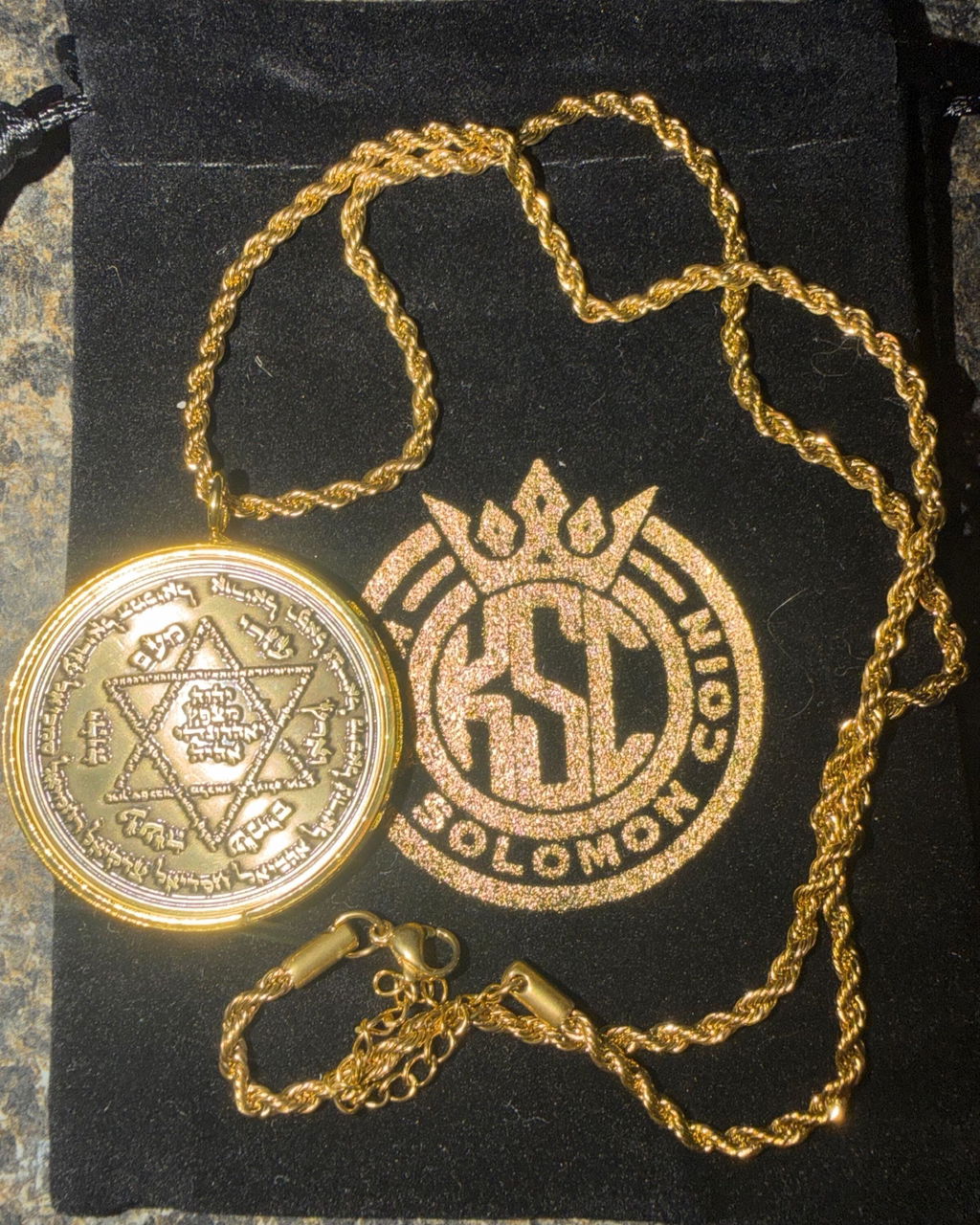
This coin is struck in solid brass and carries the sigil of Furcas on the front face, drawn from the historical Ars Goetia manuscript tradition. The reverse carries the 72 Names of God in Hebrew. These 72 divine names, derived from Exodus 14:19-21 in the Kabbalistic tradition, are the source of the authority that Solomon held over the 72 spirits of the Goetia. Their presence on the reverse places the sigil within the complete Solomonic framework.
The 72 Names are engraved only on the first day of the Hebrew month, following the traditional requirement maintained by the maker of these coins from the beginning of this practice. The coin is a deliberately made object designed to connect you to a tradition of intellectual and spiritual practice with roots stretching back through centuries of manuscript transmission.
Frequently Asked Questions About Furcas
What is the Furcas sigil used for?
In the Solomonic tradition, Furcas teaches philosophy, astronomy, rhetoric, logic, chiromancy, and pyromancy. In talisman practice, the Furcas sigil is carried as a focal point for intellectual clarity, the quality of sustained attention that difficult study requires, and the ability to think rigorously and communicate clearly.
Is Furcas the only Knight in the Ars Goetia?
Yes. Furcas is the sole spirit in the 72 listed in the Ars Goetia who holds the rank of Knight. All other spirits hold ranks of King, Duke, Prince, Marquis, Count, President, or Earl. This unique rank has drawn the attention of scholars studying the internal hierarchy of the Goetic system.
What do the disciplines taught by Furcas have in common?
Philosophy, astronomy, rhetoric, logic, chiromancy, and pyromancy are all disciplines that train the mind to perceive hidden structure: in arguments, in the heavens, in the human body, and in natural phenomena like fire. They are systems for moving from visible surface to hidden meaning, which connects them to the broader Solomonic tradition of working with what is behind the apparent.
Why does Furcas appear as an old man with a pale horse?
The pale horse in Western tradition is associated with long journeys, ancient time, and the passage from one state to another. The cruel old man on a pale horse is a figure who has traveled far through time and accumulated knowledge that younger, more comfortable figures have not. The sharpness of his weapon suggests that the knowledge he carries has an edge: real, demanding, capable of cutting through confusion.
Carry the Seal of Furcas
The Furcas sigil coin is struck in solid brass with the 72 Names of God on the reverse, engraved on the first day of the Hebrew month in keeping with the Solomonic tradition.
→ Furcas Demon Sigil Coin - Solid Brass with 72 Names of God