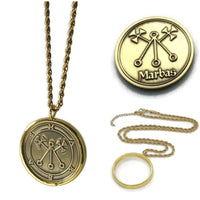
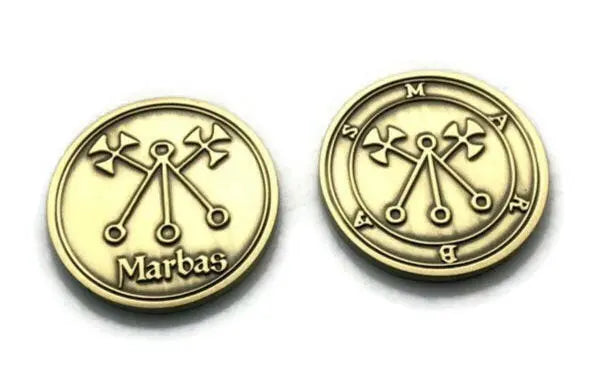
Marbas demon sigil coin Ars Goetia features a double sided brass design inspired by classical Solomonic manuscripts. This coin presents two traditional sigils associated with Marbas, offering a detailed collectible for those interested in historical symbolism and Western esoteric traditions.
Marbas Demon Sigil Coin - Meaning and Historical Context
This Marbas demon sigil coin is based on traditional sources such as the Lesser Key of Solomon. Marbas is described as a President within the Ars Goetia, associated with structured hierarchies and symbolic interpretation.
Marbas sigil: drawn from classical manuscripts
Ars Goetia: historical grimoire of spirit hierarchies
President classification: part of traditional systems
Symbolic design: focused on structure and calligraphic form
Because of this structure, the coin serves as both a collectible and a study piece.
Primary Sigil of Marbas (Side 1)
The front side displays the primary seal associated with Marbas. This design is based on traditional illustrations found in historical texts.
The sigil reflects structured line work and symbolic arrangement. It is often studied for its visual composition and historical significance.
Alternate Marbas Sigil (Side 2)
The reverse side presents an alternate sigil associated with Marbas. This version appears in later sources and comparative studies of demonological traditions.
By comparing both sides, collectors and researchers can observe variations in symbolic representation. This adds depth to the study of sigil evolution.
Historical Context
Marbas is listed as the fifth spirit in the Ars Goetia. Classical texts describe this figure as associated with hidden knowledge, transformation, and symbolic systems within historical literature.
The name also appears in variant forms such as Margas and Barbas across different manuscripts. These variations reflect differences in historical transmission.
Craftsmanship and Material
This coin is made from durable brass with a gold tone finish. The material provides strength while maintaining a classic and collectible appearance.
In addition, the engraving highlights fine details of both sigils. This ensures clarity and precision for study and display purposes.
Product Details
Material: brass
Color: gold tone
Diameter: 1.50 inches
Thickness: 2.9 mm
Weight: 0.8 oz
Design: double sided engraving
Packaging: PVC coin sleeve
This Marbas demon sigil coin is designed for durability, historical detail, and collectible value.
Intended Use
This coin is created for collection, display, and educational study. It is suitable for those interested in historical manuscripts, symbolic systems, and Western esoteric traditions.
No rituals or instructions are included or implied.
Learn More About the Ars Goetia
This coin is part of the Ars Goetia series. Visit the full reference page to explore all 72 seals from the Lesser Key of Solomon.
Deeper Meaning of Marbas
Marbas holds the fifth position in the Ars Goetia and carries the rank of President, commanding 36 legions of spirits. The Lemegeton describes Marbas as appearing first in the form of a great lion before putting on human shape at the request of the exorcist, an iconographic pattern that connects this spirit to the solar and regal symbolism traditionally associated with the lion in medieval and Renaissance natural philosophy. According to the Lemegeton, he answers truly of things hidden or secret, causes diseases and cures them, gives great wisdom and knowledge in mechanical arts, and can change men into other shapes. The variant names Margas and Barbas across different manuscript traditions reflect the textual transmission difficulties common to grimoire literature, where non-standard names were subject to considerable copyist variation across scribal generations. The association with hidden knowledge and the mechanical arts situates Marbas within a Renaissance intellectual discourse that recognized a meaningful continuity between natural magic and what we would now call natural philosophy: both were understood as legitimate inquiries into the structure and principles of the created order, conducted through different but complementary methods. Marbas is the fifth of the six spirits attributed to Aries. The sigil geometry reflects the methodical precision attributed to this spirit in source texts, with clean angular lines suggesting systematic rather than chaotic forms of symbolic authority over natural phenomena.
Frequently Asked Questions
What rank does Marbas hold in the Ars Goetia?
Marbas holds the rank of President and occupies the fifth position in the Ars Goetia. Marbas commands 36 legions of spirits.
Why does Marbas appear as a lion in classical manuscripts?
The lion form attributed to Marbas in manuscript sources draws on the solar and regal symbolism traditionally associated with the lion in medieval and Renaissance natural philosophy. Lions were understood as the king of animals in classical natural history, making the lion an iconographically appropriate initial form for a President-ranked spirit associated with authority over natural knowledge and the mechanical arts.
What variant names does Marbas appear under in historical sources?
Marbas appears under the variant names Margas and Barbas across different manuscript traditions, reflecting the textual transmission challenges inherent in preserving non-standard spirit names through multiple scribal generations. These variants are documented across major Lemegeton manuscript families and provide scholars with useful textual markers for comparing different manuscript lineages.
What subject areas is Marbas associated with in the Lemegeton?
The Lemegeton says Marbas answers truly of things hidden or secret, causes diseases and cures them, gives great wisdom and knowledge in mechanical arts, and can change men into other shapes. These associations situate Marbas within a Renaissance intellectual tradition that recognized meaningful continuity between natural magic and natural philosophy: both were understood as legitimate systematic inquiries into the structure and operative principles of the created order, conducted through different but complementary methods.
Do Presidents in the Ars Goetia appear in human form?
Not as a rule. The Lemegeton describes each spirit's appearance individually, and rank does not decide the form. Marbas himself first appears as a great lion, and Botis, another President, first appears as an ugly viper. Both take on human shape only when commanded.
Related Ars Goetia Seals
Bael (King, #1) | Agares (Duke, #2) | Vassago (Prince, #3) | Samigina (Marquis, #4) | Botis (President/Earl, #17) | Furcas (Knight, #50)