Marbas Demon Sigil Meaning: Ars Goetia President of Healing and Solomonic Seal Guide
Marbas Demon Sigil Meaning: Ars Goetia President of Healing and Solomonic Seal Guide

Healing, concealed knowledge, and the mechanics of the physical world converge in the figure of Marbas, the fifth spirit listed in the Ars Goetia. Listed as a Great President commanding 36 legions, Marbas appears first as a lion, then transforms into a man. His manuscript profile is one of the most medically significant in the entire Goetia: he both causes and cures diseases, answers questions about things hidden and secret, and teaches mechanical arts. This post traces his origins in the Solomonic manuscripts, examines what his sigil represents, and explains the tradition behind the coin made in his name.
Who Is Marbas in the Ars Goetia?
The Ars Goetia is the first book of the Lemegeton Clavicula Salomonis, a major 17th-century grimoire compiled from earlier manuscripts. It catalogues 72 spirits said to have been bound by King Solomon using his divine ring and seal. Each spirit is assigned a rank, a number of legions, a visual description, and a set of powers.
Marbas is the fifth spirit, holding the rank of President. In the Goetic hierarchy, Presidents are powerful spirits whose rank places them above many others in terms of the scope and reliability of their powers. Marbas commands 36 legions, one of the larger numbers in the text.
His initial appearance as a great lion is significant. Across mythological and esoteric traditions, the lion is a symbol of strength, sovereignty, and primal power. The sun, which governs vitality and health in Kabbalistic and astrological systems, is ruled by the lion (Leo). A spirit who first appears as a lion and then becomes a man suggests a movement from raw natural force to focused human intelligence, which aligns with Marbas's attributed powers: not brute force but the precise knowledge of how the body and the physical world work.
The Ars Goetia specifically notes that Marbas can cause and cure diseases. This two-sided nature is not unique to Marbas in the grimoire tradition: many healing spirits and saints in various traditions are described as capable of both inflicting and removing illness, because understanding the cause of a disease is the same knowledge required to cure it. A spirit who knows how illness works can work in either direction with that knowledge.
The Sigil of Marbas: Origins and Design
Each of the 72 spirits in the Ars Goetia is assigned a unique sigil: a geometric symbol that serves as that spirit's name written in a visual language. These sigils were derived through systematic methods using magical alphabets and letter-to-geometry cipher systems. Once established, they were copied with care across the manuscript tradition because they were considered precise instruments, not decorative marks.
The sigil of Marbas appears in the major manuscript versions of the Ars Goetia with consistent form, including in the Sloane manuscripts at the British Library and in the widely-read 1904 Mathers-Crowley edition. Its form suggests interlocking curves and crossed lines that scholars have associated with the combining and balancing quality central to Marbas's nature: the same force that harms can heal, the same knowledge that reveals can conceal.
The name Marbas itself has been analyzed by several scholars. Some connect it to roots in Semitic languages suggesting a combination of lord and seeking or inquiring, which would connect his name etymologically to the inquisitive, knowledge-revealing aspects of his powers. Others note variants in manuscript sources, including the names Margas and Barbas, suggesting the name may have passed through multiple transliteration systems before arriving in its current form.
Marbas and the Healing Tradition
The healing power attributed to Marbas connects him to one of the oldest and most widespread uses of talismanic objects in human history. Across every culture and period, people have sought objects, inscriptions, seals, and symbols to protect the body from illness and to aid recovery. The Solomonic tradition is one of the most sophisticated expressions of this universal practice.
In medieval practice, practitioners who sought the aid of Marbas were typically physicians, surgeons, or those seeking healing on behalf of sick family members. The sigil of Marbas would be inscribed on parchment, metal, or wax and kept near the patient or carried by the healer as a focus for the healing work. The coin in this series serves this same talismanic function in a contemporary, durable form.
The ability to answer questions about hidden things places Marbas alongside the divinatory spirits, but with a specifically diagnostic orientation. In a medical context, the hidden thing is the source of the illness, the cause that is not yet known. Marbas's power to reveal concealed knowledge therefore works directly in service of his healing function: find what is hidden, understand the cause, remove the illness.
Mechanical Arts and the Knowledge of How Things Work
The attribution of mechanical arts to Marbas is less discussed than his healing powers but equally interesting. Mechanical arts in the historical sense of the term referred to skilled crafts and physical knowledge: metalworking, construction, the working of machines, the understanding of how physical systems function. This connects Marbas to the tradition of Hermetic and Solomonic thought that saw practical knowledge of the physical world and spiritual knowledge as part of the same continuum.
A spirit who understands the workings of the human body, who knows how illness arises and how it can be reversed, naturally extends that understanding to the workings of physical objects and systems more broadly. In contemporary terms, people drawn to Marbas often work in fields involving physical diagnosis and repair: medicine, engineering, building, and any craft that requires understanding how things break and how they can be made to work again.
How the Marbas Sigil Coin Is Made
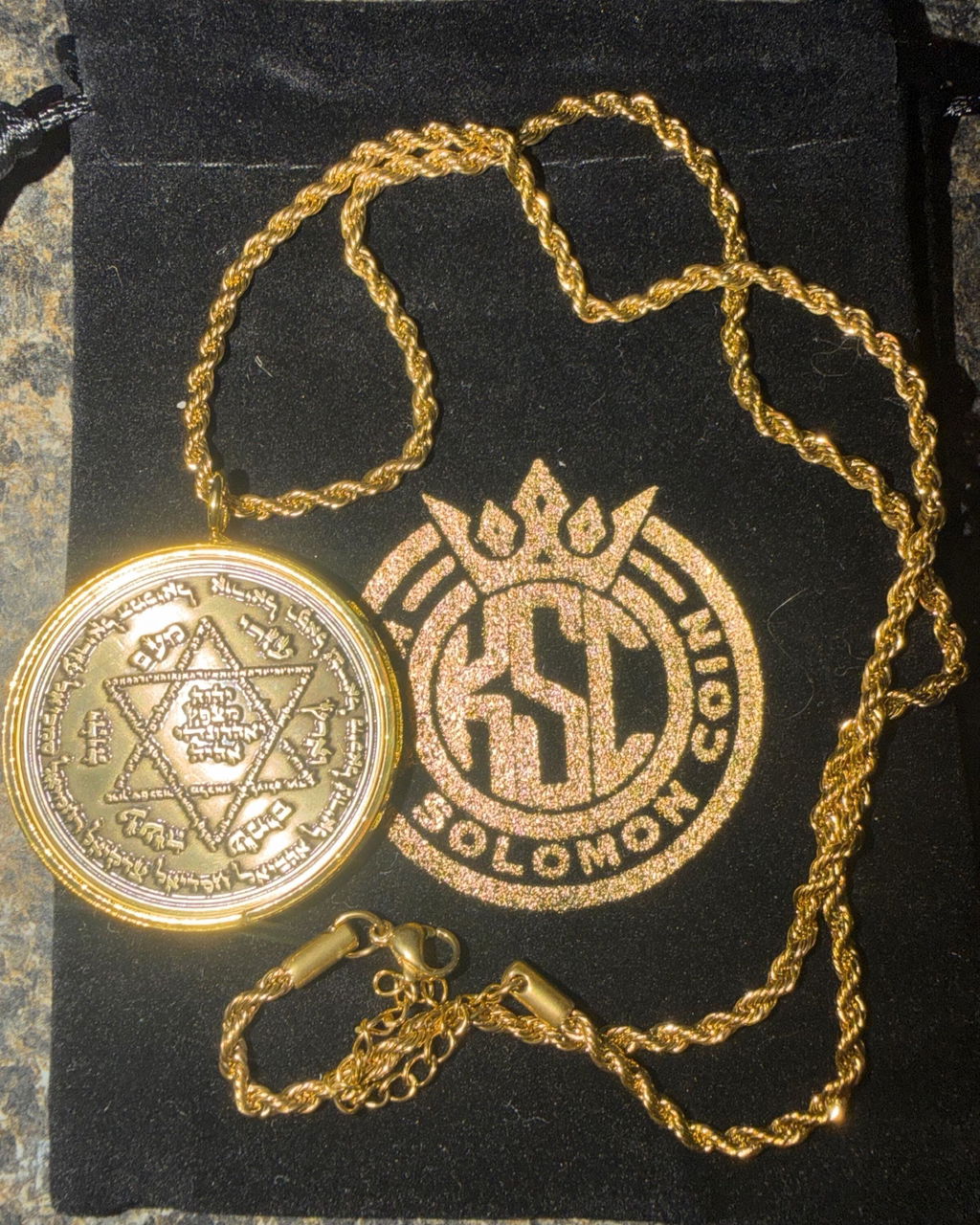
This coin is struck in solid brass and carries the sigil of Marbas on the front face, reproduced from historical Ars Goetia manuscript sources. The reverse carries the 72 Names of God in Hebrew. These are the 72 three-letter divine names derived from Exodus 14:19-21, which in the Solomonic tradition are the source of the authority that bounds and directs all 72 spirits of the Goetia. Their presence on the reverse places the sigil within the complete Solomonic framework.
The 72 Names are engraved only on the first day of the Hebrew month, following the traditional requirement maintained by the maker of these coins. The coin is made to carry, to wear, and to use as a focus for intention in whatever way is meaningful to you.
Frequently Asked Questions About Marbas
What is the Marbas sigil used for?
In the Solomonic manuscript tradition, the Marbas sigil is associated with healing, the revelation of hidden things (particularly the causes of illness), and knowledge of mechanical arts. In talisman practice, it is carried as a focal point for health intentions, diagnostic clarity, and the understanding of how physical systems work.
Can Marbas cause illness as well as heal it?
The Ars Goetia specifically states that Marbas can both cause and cure diseases. This dual attribution is common in the grimoire tradition and reflects the understanding that a spirit who knows the source of illness works with the same knowledge whether preventing or causing harm. In talisman practice, the coin is used with healing intent, within the protective framework of the 72 Names on the reverse.
What rank does Marbas hold in the Ars Goetia?
Marbas holds the rank of Great President, commanding 36 legions of spirits. Presidents in the Goetic hierarchy are associated with direct action, knowledge, and results, and Marbas is considered one of the more straightforward of the 72 spirits in terms of working with his attributed powers.
What does the lion form of Marbas represent?
Marbas's initial lion form connects him to traditions of strength, vitality, and solar energy. The lion is associated with the sun across numerous esoteric traditions, and the sun governs health and vitality in astrological and Kabbalistic systems. His shift from lion to man in the manuscripts suggests the channeling of primal force into precise, human-directed knowledge.
Carry the Seal of Marbas
The Marbas sigil coin is struck in solid brass with the 72 Names of God on the reverse, engraved on the first day of the Hebrew month in keeping with the Solomonic tradition.
→ Marbas Demon Sigil Coin - Solid Brass with 72 Names of God