Botis Demon Sigil Meaning: Ars Goetia President of Past and Future and Solomonic Seal Guide
Botis Demon Sigil Meaning: Ars Goetia President of Past and Future and Solomonic Seal Guide

When the Ars Goetia describes Botis, it gives him two ranks: Great President and Earl. He commands 60 legions, one of the largest numbers in the entire catalogue of 72 spirits. He appears first as an ugly viper, then transforms into a man with large teeth and two horns, carrying a bright and shining sword. He answers all questions about the past and future, and he reconciles friends and foes. This post traces his origins in the Solomonic manuscripts, examines what his sigil represents, and explains the tradition in which this coin was made.
Who Is Botis in the Ars Goetia?
The Ars Goetia is the first of five books in the Lemegeton Clavicula Salomonis, the Lesser Key of Solomon, a 17th-century grimoire drawing on earlier manuscript sources. Its 72 spirits are catalogued with their names, ranks, visual descriptions, powers, and sigils. They are said to have been bound by King Solomon using the divine authority of his ring, seal, and the 72 Names of God, and to be available to those who work within that same authority.
Botis is the seventeenth spirit in the list. He holds the double rank of Great President and Earl, which is unusual in the Goetia: most spirits hold a single rank. The combination suggests a spirit of broad scope, capable of both the direct action associated with Presidents and the administrative authority associated with Earls within the Goetic hierarchy.
His opening form as a viper connects him to one of the most ancient symbols in human spiritual practice. The serpent or viper appears in Egyptian, Mesopotamian, Hebrew, Greek, and numerous other traditions as a figure associated with hidden knowledge, transformation, and time. The viper sheds its skin and renews itself, connecting it to cycles of past and future. Botis's transformation from viper to armed man suggests a movement from raw cyclical knowledge into decisive, sword-bearing authority over what has been and what is to come.
The sword he carries is described as bright and shining, which in esoteric symbolism represents clarity, discernment, and the ability to cut through confusion to reach truth. A spirit who answers questions about the past and future, and who carries a sword of clarity, is a figure of revelation: he does not obscure, he illuminates.
The Sigil of Botis: Design and Manuscript Sources
The sigil of Botis is the geometric mark assigned to him in the Solomonic manuscripts, derived through the standard process of converting the letters of his name into a connected visual form using magical cipher systems. Like all 72 sigils in the Ars Goetia, it appears with high consistency across the manuscript tradition, reflecting the seriousness with which these marks were treated as precise technical instruments rather than decorative labels.
The visual form of the Botis sigil contains angular and curved elements that converge at a central point, which can be read as the bringing together of past and future into a single moment of clarity. Whether or not one reads symbolic meaning into the geometry, the practical function of the sigil in Solomonic practice was straightforward: it was the address, the name-in-picture, that directed a practitioner's intention toward Botis specifically and no other spirit.
The manuscripts that preserve the Botis sigil include the Sloane manuscripts in the British Library, dating from the late 17th century, and several other closely related texts. The double-rank attribution (President and Earl) is consistent across these sources, which strengthens confidence that this was an original feature of the tradition rather than a later addition or copyist's error.
Powers of Botis: Past, Future, and Reconciliation
The two powers attributed to Botis in the Solomonic manuscripts are complementary. The first is knowledge of the past and future. The second is the ability to reconcile friends who have become enemies, and enemies who have never been friends.
The temporal knowledge attributed to Botis is broader than the more specific divinatory powers of some other Goetic spirits. He does not specialize in hidden objects (Vassago) or prophecy about a single situation. He speaks to the full arc of time: what has already occurred and what is moving toward you. In practice, this was sought by those who needed to understand the full context of a situation, to see both the history that brought things to a current state and the likely direction ahead.
The reconciliation power is one of the most socially significant in the entire Goetia. Human relationships fracture. Friends become enemies through misunderstanding, insult, betrayal, or simply the grinding pressure of difficult circumstances. The ability to restore what has been broken between people was enormously valuable in a world where alliances determined survival, where family conflicts determined inheritance, and where enmity with powerful people could be genuinely dangerous. Botis was sought to smooth these fractures and to rebuild what had been broken.
In contemporary talisman practice, the Botis sigil is carried by people navigating difficult relationship situations, by those trying to understand the full history of a complex situation, and by those who need clarity about where things are heading. The combination of temporal clarity and relational repair makes his sigil one of the most practically oriented in the entire Goetic series.
The Solomonic Framework Behind This Coin
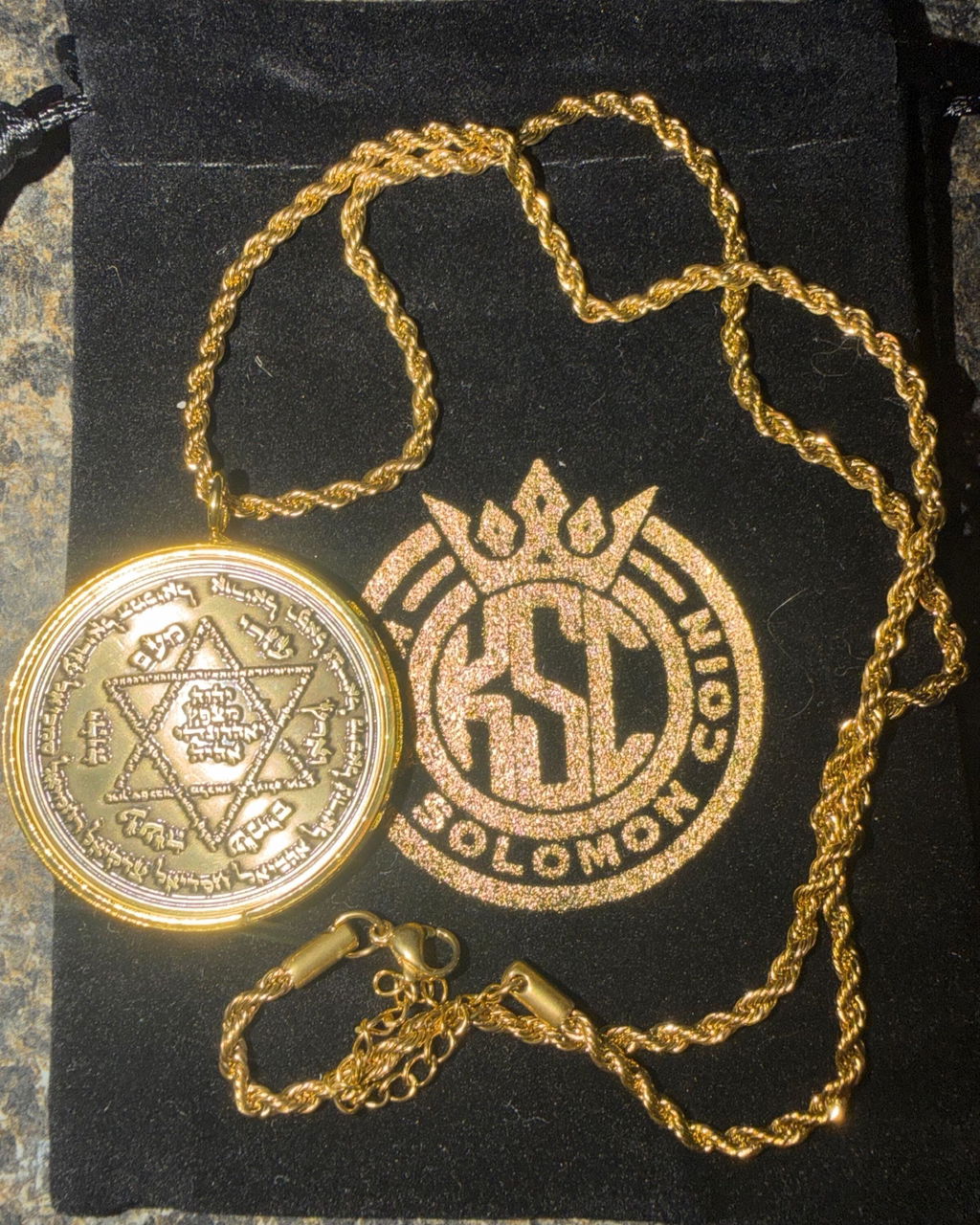
The coin in this series carries the sigil of Botis on the front face, reproduced from the historical Ars Goetia manuscript tradition. The reverse carries the 72 Names of God in Hebrew. In the Solomonic worldview, the 72 Names are the divine names that gave Solomon his authority over all 72 spirits. Their presence on the reverse of every coin places the sigil within the complete Solomonic framework: the spirit named on one face, the divine authority that names it on the other.
The 72 Names are engraved only on the first day of the Hebrew month, following the traditional requirement maintained by the maker of these coins from the beginning of this work. This is not a decorative or ceremonial gesture. It is a practical constraint rooted in the understanding that the names carry power specifically when worked at the appointed time.
Carrying the Botis Sigil
People carry the Botis sigil coin in situations where they need temporal clarity or relational repair. Those working through complicated histories, trying to understand what led to a current situation and what is likely ahead, find his sigil useful as a focal point for that kind of clear seeing. Those navigating broken relationships, working toward resolution with people they have been in conflict with, or seeking to rebuild something that has been damaged, often find the reconciliation quality of Botis directly relevant to what they are working through.
As with any talisman in any tradition, the coin is a focal point for intention. The symbol has centuries of accumulated meaning behind it. The carrier brings their own clarity, sincerity, and attention to what the symbol points toward.
Frequently Asked Questions About Botis
What is the Botis sigil used for?
In the Solomonic tradition, Botis is associated with knowledge of past and future events and the reconciliation of friends and enemies. In talisman practice, the sigil is carried as a focal point for temporal clarity, understanding the full arc of complex situations, and work aimed at restoring broken relationships.
Why does Botis hold two ranks in the Ars Goetia?
Botis is described as both a Great President and an Earl, which is unusual in the Goetia where most spirits hold a single rank. This double attribution is consistent across the major manuscript sources. It is interpreted by scholars as indicating a spirit of unusually broad scope and authority, capable of both direct action (President) and administrative command (Earl).
What does the viper form of Botis represent?
The viper connects Botis to ancient symbolism of cycles, transformation, and hidden knowledge. The serpent sheds its skin and renews itself, making it a natural symbol for a spirit associated with time and the arc from past to future. His transformation into a man with a bright sword represents the bringing of this cyclical knowledge into sharp, decisive clarity.
How many legions does Botis command?
Botis commands 60 legions of spirits, one of the larger numbers in the Ars Goetia. For comparison, Bael commands 66 and Agares commands 31. The larger command numbers generally correspond to spirits of greater power and scope within the Goetic hierarchy.
Carry the Seal of Botis
The Botis sigil coin is struck in solid brass with the 72 Names of God on the reverse, engraved on the first day of the Hebrew month in keeping with the Solomonic tradition.